November 1, 2026 by Bob Robinson Special to the Democrat-Gazette
Link to Democrat Gazette article:
https://www.arkansasonline.com/news/2026/nov/01/wild-and-scenic-rivers-memorable-float-trips/
[photo credit: Special to the NWA Democrat-Gazette]
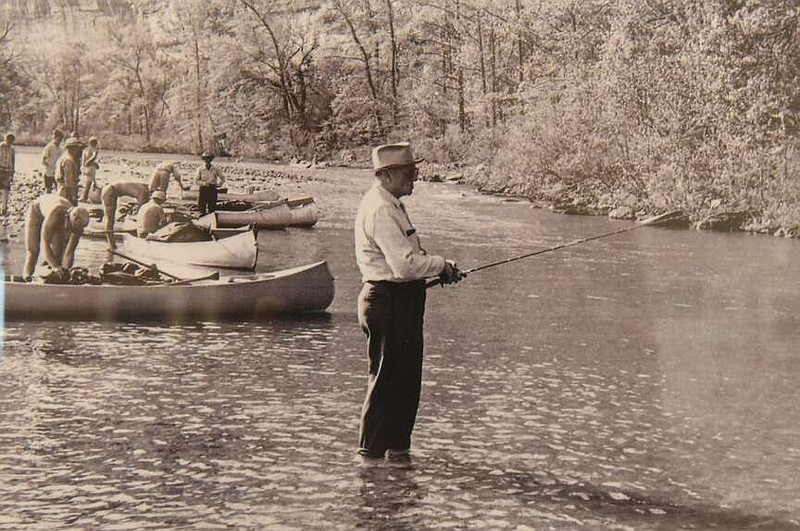
In 1961, Supreme Court Justice William O. Douglas saw a photograph in Time magazine devoted to outdoor recreation in America. It included a beautiful, full-page color photograph of a canoeing party camped under Big Bluff on the Buffalo River in Arkansas. He was struck by the scene and wanted to visit.
A close aide contacted Harold and Margaret Hedges, members of Ozark Wilderness Waterways Club. The couple gladly offered to escort him on a float of the Buffalo in the coming spring of 1962. Neil Compton, founder of the Ozark Society, joined them on the float.
Douglas’ monumental outing proved to be a major turning point for the movement to preserve the Buffalo River. The trip was widely covered by the media, and the majestic waterway gained a staunch supporter with political connections.
Douglas proclaimed, “You cannot let this river die. The Buffalo River is a national treasure worth fighting to the death to preserve.”
Paddling at the base of Roark Bluff, a 220-foot-high, 3/4-mile-long limestone wall, and camping on polished gravel bars were all it took to convince him.
After the three-day float, Douglas was convinced that preserving the experience for future generations was the highest priority. After years of effort to preserve the river, the battle was won. On March 1, 1972, Congress designated 135 miles of the Buffalo as the nation’s first national river. However, the upper portion of the river was not included. Those headwaters were part of the Ozark National Forest, which provided some protection from development but not as much as a national river designation would. On April 22, 1992, Congress signed the Arkansas Wild and Scenic Rivers Act, which included the Upper Buffalo River. Finally, the entire Buffalo River would remain free flowing.
This uppermost section of the river offers a unique wilderness experience not found on the rest of the river. Once you launch your boat at its origin, you are committed to running the entire 15.8 miles. The limited access helps preserve the river’s wild character. The narrow canyon offers challenging gradient, rapids, exposed bedrock, sharp ridges, and forested wilderness.
VIRGIN RUN ON THE HAILSTONE
The highlight for most boaters’ Upper Buffalo WSR adventure is what many consider the wildest whitewater on the entire Buffalo River: Hailstone.
In an article in the Ozark Society Bulletin, Margaret Hedges shared the following story of an especially memorable float — June 15, 1974 — when she fulfilled a promise she made to herself nine years earlier. On that date, she and her husband, Harold, were searching for new stretches of canoeable water.
Virgin water was becoming increasingly rare, even back in 1965. Paddlers had to scour extreme upper headwaters of streams, where water flow was intermittent and the gradient steep. On one such exploration, during a colorful fall outing in the Ozarks, they forded a small scenic drainage in the Upper Buffalo River. Although it was little more than a trickle, Margaret vowed to return someday. And bring a canoe.
After studying topo maps, she discovered that with an average plummet of 35 feet per river mile, the float was triple the drop of most of their whitewater experiences.
Harold thought it was a foolhardy ride and said he would not join her. But Margaret had been planning the trip for nine years, and nothing was going to make her give up now.
Being “trip leader,” she knew she had to choose her float companions carefully. With visions of long portages and broken canoes, she needed strong, eager paddlers. Deciding that three canoes were the right number for the outing, she put together a team of experienced paddlers that included Coleman Holt and brothers Steve and Stewart Noland. Luckily, Harold changed his mind two days before the outing, so he filled the stern seat on her own canoe.
With the float being only 13 miles, the group was confident they would run it in a single day. In case of an emergency, they agreed to pack lightly for an overnight camp.
They hired Doy Scoggins to accompany them to the put-in and drive their vehicle to the takeout. When hearing of Margaret’s plan, he warned, “You’ll be a long ways from help if you need it. Nobody takes a boat up here.”
Which was exactly why they were there: A virgin float.
After dragging downed limbs out of the approach road and filling bad washouts with rocks, the group arrived at the sandy bank. Margaret smiled with smug delight. The stream was as beautiful as she remembered.
By common consent, the “trip leader” went first. Immediately, they brushed a tall alder leaning across the stream. Following this, they were curving down their first drop out of view of the others. Excitement was in the air.
As they got a feel for the river, Coleman, riding solo, paddled past them to take the lead. He maneuvered the coming rocky chutes and rolling waves expertly.
Next, they flowed into a 50-foot stretch that required multiple zigzag maneuvers through a gorge that had been cut through a huge boulder pile. This was their first taste of real white water, and it was exhilarating.
The farther they distanced themselves from the put-in, the more impressive the scenery became. Waterfalls poured down the bordering bluffs into the river, and ferns blanketed the banks.
Coleman led the group to the river’s right bank to scramble over a pile of rocks choking the channel. Margaret was completely unprepared for the sight that greeted them. The river plunged through a gap in the rocks no wider than a canoe. Exiting on the opposite side, the water erupted in all directions, spreading its frothy waters over submerged boulders. They fittingly named this Overlayed Falls.
Coleman steered the bow of his Blue Hole through the gap, gliding smoothly in the foaming waters below. The Noland brothers were next. Their technique was perfect as they hit the “V” right on target. But the sharp keel of their overloaded aluminum Grumman ran aground on a barely submerged rock.
With a series of deep strokes, Harold and Margaret headed for the gap. Their canoe tilted dangerously. Unable to correct it, Harold was abruptly pitched out of the boat. Margaret slid forward off her seat, expecting to join her husband in the turbulent water. To her surprise and delight, the craft rose, pushing her gracefully back into her seat.
By the time they pulled ashore for lunch, they had encountered 47 rapids during the 2 ½ miles they had covered. It was great fun rehashing the morning’s adventures and lolling in the shade. With more than 10 miles remaining, they knew they had to move on.
They began the afternoon as they had in the morning. Struggling through rock gardens and roaring rapids, the party was immersed deeper into wonderful wilderness, along the way christening rapids such as No Way, Triple Threat, and Bloody Keyhole.
The beautiful June day was soon marred by gathering clouds. The first drops of rain sent everyone scrambling for rain gear. Droplets became hard balls of ice. Instantly, their world was like an explosion in a ping-pong factory.
They steered for the shore, reasoning the trees would take some of the sting out of the hailstones. When the storm finally passed, they were greeted by a totally new environment. The air was cold, the river was cold, they were cold, and the ground was covered in white.
At this point, it was clear they would not make the takeout before dark. The search for a suitable campsite began. They chose a level spot well above the high-water mark and set up their tent village.
As Margaret watched Stewart and Steve Noland establish camp, it became obvious why their canoe had been riding so low. Their load included a special oven for cooking biscuits, a cast-iron skillet, and ample groceries, including enormous ham steaks for the entire group. A welcome feast was enjoyed by all.
On day two, the rapids were farther apart, but the river was fast and frothy. Several big rapids, including “Deliverance Falls,” were encountered. This rapid included the trip’s steepest single drop, and just beneath the falls, a huge boulder blocked the path.
At the end of the day, as they loaded their equipment into the waiting vehicle, Margaret summed up the adventure: “This place had everything. I mean everything it required to keep almost anyone from attempting to run it.”
As Stewart Noland reflected on the outing, “One trip, one event, hail, and it will forever be referred to as the Hailstone, as dubbed by Margaret.”
PRESERVED WILDNESS
At the conclusion of their Great Hailstone Adventure, the entire group vowed to return. Stewart Noland floated Hailstone on more than 25 occasions. Over half a century later, he says the wildness experienced on that virgin run remains preserved.
Untrampled wilderness, no distant rumble of highway traffic, no human voice to be heard, no farm or groomed pasture, no remnants of man’s presence. The opportunity exists to experience the Arkansas of our early ancestors.
A Native American adage says it best: “We do not inherit the Earth from our ancestors; we borrow it from our children.”
Bob Robinson is a born-and-raised Arkansan. From childhood to the present day, he enjoys all the outdoor activities that make Arkansas “The Natural State.” He has written several bicycle touring books: “Bicycling Guide to the Mississippi River Trail,” “Bicycling Guide to Lake Michigan Trail” and “Bicycling Guide to Route 66.”